Rep Ranges for Gym Training: Choosing the Right Number of Repetitions
- Aaron Li
- Bodybuilding
- July 17, 2026
Table of Contents
How Many Reps Should You Do? The Boring (But True) Answer
Gym advice often treats repetition ranges like separate lanes: low reps for strength, moderate reps for muscle, and high reps for endurance. That chart is easy to remember. It is also too neat.
For muscle growth, there is no uniquely superior rep range. Heavy, moderate, and fairly light weights can all build muscle when the working muscles are pushed hard enough, the training becomes more demanding over time, and the workload is recoverable. Reviews consistently find similar hypertrophy across a broad range of loads, while heavier training usually produces larger gains in one-repetition-maximum strength (Schoenfeld et al., 2017; Lopez et al., 2021; Currier et al., 2026).
That doesn’t make rep range irrelevant. It changes what a set feels like, what tends to limit it, and which performance skill improves most.
Rep ranges still shape the result
A repetition is one complete performance of an exercise. The load is the resistance you use, usually expressed in pounds, kilograms, or as a percentage of the heaviest weight you can lift once. A weight you can manage for five reps is heavier than one you can lift for twenty, even if both sets eventually become difficult.
Heavy training is the clearest choice when maximal strength is the main goal. Strength is partly specific to the task. Someone who wants a bigger squat needs practice handling heavy squats, staying tight under them, and producing high force against loads close to a maximum. Lighter sets can build the muscle that contributes to strength, but they provide less practice with the actual skill of heavy lifting. This is why low-load and high-load programs can produce similar muscle growth while the heavier program improves the one-rep max more (Schoenfeld et al., 2017; Lopez et al., 2021).
Higher-repetition work is more specific to muscular endurance, which is the ability to repeat contractions before fatigue stops the set. Training with sets of twenty or thirty teaches the muscles to keep working during longer efforts and makes the pacing and discomfort more familiar. A person who only trains triples shouldn’t expect to be unusually good at a fifty-rep challenge simply because the same muscle is involved.
Power needs a different kind of thinking. Power is force produced quickly, so repetition count alone cannot define power training. Load, movement speed, intent, technique, and fatigue all matter. Jumps, throws, Olympic-lift variations, and other explosive exercises are usually performed with enough rest and few enough reps that speed stays high. Continuing until every repetition slows into a grind turns power practice into something else (Currier et al., 2026).
For general fitness, several ranges work. The sensible choice depends on the exercise, equipment, comfort, and how much time someone wants to spend breathing through a set.
Why heavy and light sets can both build muscle
Muscles are controlled through motor units. A motor unit is a nerve cell and the muscle fibers it controls. Smaller, lower-threshold units are recruited first. Larger, higher-threshold units join in when more force is needed.
A heavy weight requires a lot of force immediately, so high-threshold motor units are recruited early. A light weight starts differently. The first few reps may rely more on lower-threshold units, but those fibers gradually fatigue. The nervous system then recruits additional units to keep the weight moving. Near the end of a hard light-load set, many of the larger units can be working even though the dumbbell itself isn’t especially heavy (Flewwelling et al., 2025).
This helps explain why a set of five and a set of twenty can both stimulate growth. In either case, the active fibers must produce high force relative to their current ability. That force creates mechanical tension within the muscle, one of the main signals involved in hypertrophy.
The catch is that light sets usually need to continue closer to failure. Twenty reps with a weight you could lift fifty times is mostly a warm-up with ambitions. Twenty reps when only one or two clean reps remain is a much stronger stimulus.
Very light loads can also become inefficient because the set may end from burning, breathlessness, boredom, or deteriorating technique before the target muscle receives enough useful work. In one study, training at 40, 60, and 80 percent of one-repetition maximum produced similar growth, while 20 percent produced less (Lasevicius et al., 2018).
How close to failure?
Muscular failure is the point at which another full repetition cannot be completed with the required technique. Training close to that point helps ensure that a set is challenging, especially with lighter loads. Reaching failure on every set is unnecessary and can create more fatigue than the extra stimulus is worth.
A practical way to judge effort is repetitions in reserve, or RIR. Finishing a set at two RIR means you believe you could have completed about two more good repetitions. For many hypertrophy sets, stopping somewhere around zero to three RIR is a useful guideline. It isn’t a biological cutoff. Beginners can grow while stopping farther away as they learn the movements, and a heavy squat or press may deserve more caution than a machine curl.
Research does not show a reliable hypertrophy advantage from taking every set to momentary failure instead of stopping slightly short. Sets still need to be reasonably challenging, although the exact relationship between proximity to failure and growth remains uncertain (Refalo et al., 2023; Robinson et al., 2024).
The load changes how strict that recommendation needs to be. A heavy set of five stopped with two reps left has already required substantial force and early recruitment of large motor units. A light set of twenty stopped with ten reps left probably hasn’t. “Train hard enough” is more useful than demanding the same RIR on every exercise and every set.
Choosing ranges in the real world
Moderate reps remain popular because they are convenient. Sets around six to fifteen are heavy enough to finish efficiently, yet light enough that technique and joint comfort are often manageable. They also make it easier to judge effort without cardiovascular fatigue hijacking the exercise. That is a practical advantage, not a secret muscle-building zone.
The best range changes with the movement. Squats often work well around five to ten or six to twelve reps. Higher-rep squats can build the legs, but breathing, balance, and lower-back fatigue may end the set first.
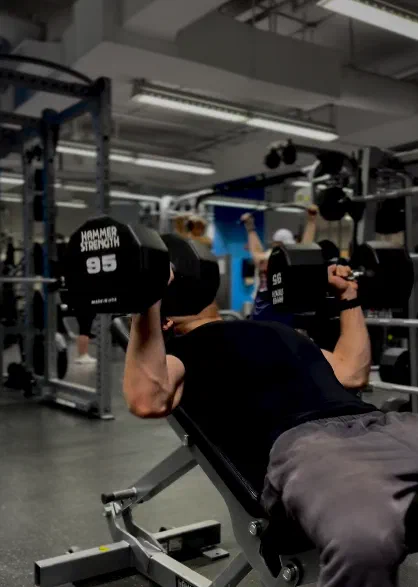
Chest presses are commonly comfortable around six to fifteen reps, though heavier or lighter work can still be productive. Lateral raises often suit twelve to thirty because using a load meant for five reps tends to produce more swinging and shrugging than shoulder training. Curls are usually easy to perform somewhere around eight to twenty, with elbow comfort and body movement setting the useful limits.
None of those numbers is mandatory. A compound lift does not automatically require low reps, and an isolation exercise does not become useless when the set drops below ten. The range should let the target muscle work hard through a controlled motion without another limitation ending the set too early.
Hypertrophy also requires a stimulus that remains challenging as the body adapts. Progress can mean adding weight, performing more reps with the same weight, improving control, or adding a productive set when more weekly volume is needed. The change should make the target muscle do more useful work, not merely make the workout feel worse.
Shortening rest periods is a good example of the difference. Less rest makes a session harder, but it can also reduce performance on later sets. For muscle growth, resting long enough to repeat high-quality work is usually more useful than racing the clock. Constantly changing rep ranges is optional too. Variation can reduce boredom or help train several goals, but a productive range does not expire after four weeks.
Use moderate reps as a default when they fit the exercise. Go heavier when strength practice matters, and use higher reps when they feel better or suit the movement. Keep most hypertrophy sets challenging, often within roughly zero to three reps of failure, while allowing room for sound technique and recovery. Then track the work and improve it over time. Muscles are difficult enough without assigning mystical powers to the number twelve.
References
Currier, B. S., D’Souza, A. C., Fiatarone Singh, M. A., et al. (2026). American College of Sports Medicine position stand: Resistance training prescription for muscle function, hypertrophy, and physical performance in healthy adults: An overview of reviews. Medicine & Science in Sports & Exercise, 58(4), 851–872. https://doi.org/10.1249/MSS.0000000000003897
Flewwelling, L. D., Hannaian, S. J., Cao, V., Chaillou, T., Churchward-Venne, T. A., & Cheng, A. J. (2025). What are the potential mechanisms of fatigue-induced skeletal muscle hypertrophy with low-load resistance exercise training? American Journal of Physiology-Cell Physiology, 328(3), C1001–C1014. https://doi.org/10.1152/ajpcell.00266.2024
Lasevicius, T., Ugrinowitsch, C., Schoenfeld, B. J., et al. (2018). Effects of different intensities of resistance training with equated volume load on muscle strength and hypertrophy. European Journal of Sport Science, 18(6), 772–780. https://doi.org/10.1080/17461391.2018.1450898
Lopez, P., Radaelli, R., Taaffe, D. R., et al. (2021). Resistance training load effects on muscle hypertrophy and strength gain: Systematic review and network meta-analysis. Medicine & Science in Sports & Exercise, 53(6), 1206–1216. https://doi.org/10.1249/MSS.0000000000002585
Refalo, M. C., Helms, E. R., Trexler, E. T., Hamilton, D. L., & Fyfe, J. J. (2023). Influence of resistance training proximity-to-failure on skeletal muscle hypertrophy: A systematic review with meta-analysis. Sports Medicine, 53(3), 649–665. https://doi.org/10.1007/s40279-022-01784-y
Robinson, Z. P., Pelland, J. C., Remmert, J. F., et al. (2024). Exploring the dose-response relationship between estimated resistance training proximity to failure, strength gain, and muscle hypertrophy: A series of meta-regressions. Sports Medicine, 54(9), 2209–2231. https://doi.org/10.1007/s40279-024-02069-2
Schoenfeld, B. J., Grgic, J., Ogborn, D., & Krieger, J. W. (2017). Strength and hypertrophy adaptations between low- versus high-load resistance training: A systematic review and meta-analysis. Journal of Strength and Conditioning Research, 31(12), 3508–3523. https://doi.org/10.1519/JSC.0000000000002200