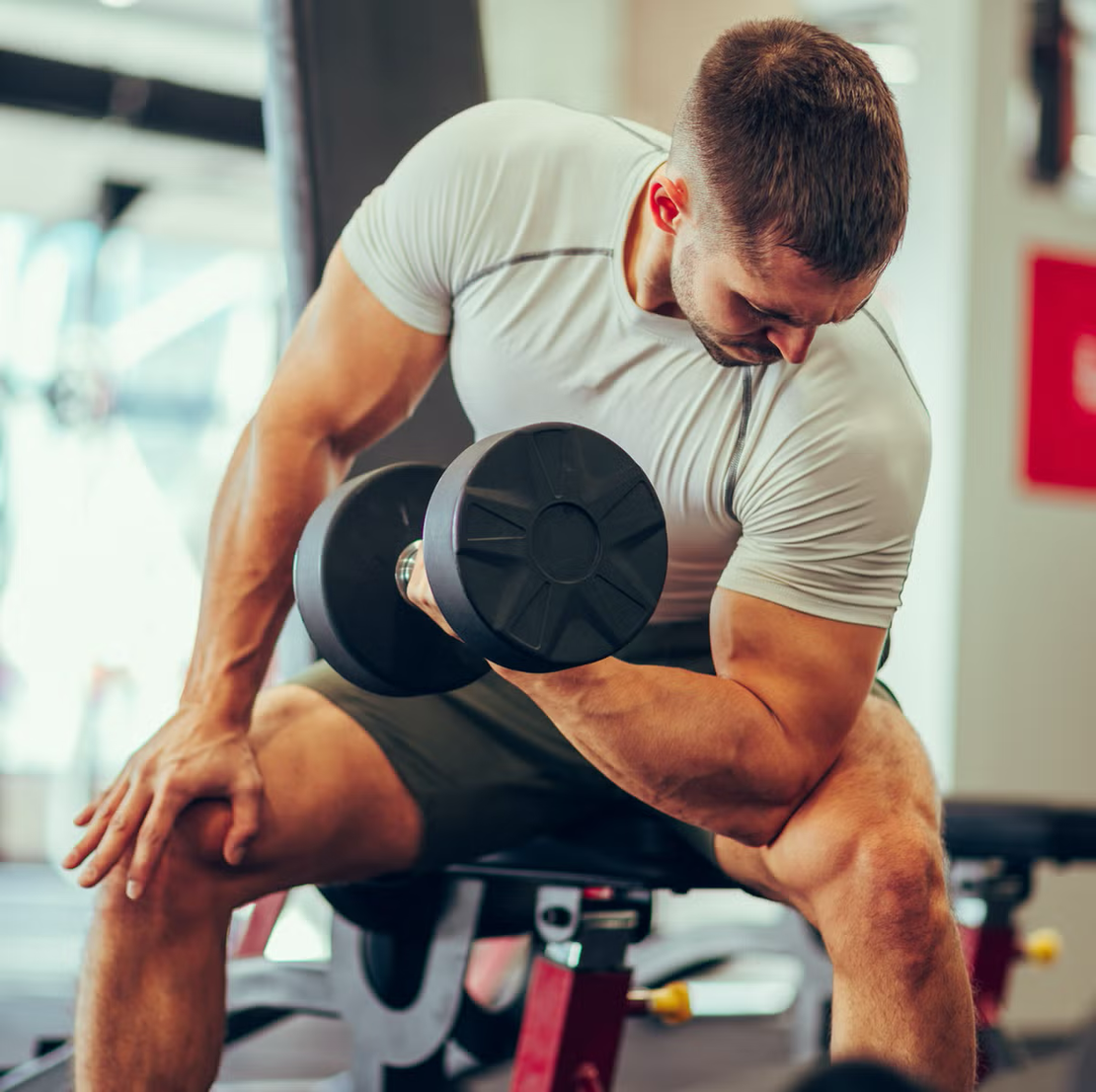
How to Build Huge Biceps
- Zev Valdina
- Bodybuilding
- April 4, 2026
Table of Contents
Building Bigger Biceps Without Overcomplicating It
Biceps training is simple enough to survive the internet. The biceps brachii has two heads and helps bend the elbow and turn the palm upward, an action called supination. The brachialis and brachioradialis also bend the elbow, so no curl isolates one muscle while its neighbors take the set off.
Palms-up curls usually give the biceps favorable leverage. Hammer curls increase the relative involvement of the brachialis and brachioradialis, while palms-down reverse curls reduce the biceps’ mechanical advantage. These are shifts in emphasis, not on-and-off switches (Murray et al., 1995).
Curls, chin-ups, pulldowns, and rows can all train the elbow flexors. What matters is whether those muscles work hard enough before something else ends the set. During a row, the upper back may fail first. On a chin-up or pulldown, grip, stability, discomfort, or technique can become the limit. The arms are still working, but the biceps stimulus may be weaker than it would be during a curl.
Short studies have found similar elbow-flexor growth from pulldowns and curls, and no clear extra arm-size benefit when direct arm work was added to a program that already contained compound exercises (Gentil et al., 2015; de França et al., 2015). These findings do not prove that curls are pointless. Direct curls simply make it easier for the elbow flexors to become the limiting muscles.
Curl variations can change shoulder and forearm position, stability, comfort, resistance through the movement, and the muscle length under load. One short study found regional differences between preacher and incline curls, while another found similar growth from cable curls performed with different shoulder positions. A meta-analysis found only trivial average differences in regional growth from training at different muscle lengths (Kassiano et al., 2025; Larsen et al., 2026; Varovic et al., 2025). Small exercise-specific effects may exist, but current evidence does not establish a dramatic long-term advantage for any curl.
Most recreational lifters need only one or two variations. A simple twice-weekly plan could use three sets of a supinated cable or preacher curl for 8 to 15 reps, followed later in the week by two or three sets of hammer curls for 10 to 20 reps. Finish most sets with about one to three good repetitions left. Someone already performing plenty of hard chin-ups, pulldowns, and rows may need less direct work.
Use double progression: keep the same weight until every set reaches the top of the rep range with consistent technique and the intended effort, then add the smallest available load and build the repetitions up again. Keep the exercises long enough to measure improvement.
Productive effort, manageable weekly volume, progression, adequate protein, and recovery matter far more than chasing tiny theoretical advantages (Currier et al., 2026; Morton et al., 2018).
References
Currier, B. S., D’Souza, A. C., Fiatarone Singh, M. A., et al. (2026). American College of Sports Medicine position stand: Resistance training prescription for muscle function, hypertrophy, and physical performance in healthy adults: An overview of reviews. Medicine & Science in Sports & Exercise, 58(4), 851–872. https://doi.org/10.1249/MSS.0000000000003897
de França, H. S., Branco, P. A. N., Guedes Junior, D. P., et al. (2015). The effects of adding single-joint exercises to a multi-joint exercise resistance training program on upper body muscle strength and size in trained men. Applied Physiology, Nutrition, and Metabolism, 40(8), 822–826. https://doi.org/10.1139/apnm-2015-0109
Gentil, P., Soares, S., & Bottaro, M. (2015). Single versus multi-joint resistance exercises: Effects on muscle strength and hypertrophy. Asian Journal of Sports Medicine, 6(2), e24057. https://doi.org/10.5812/asjsm.24057
Kassiano, W., Costa, B., Kunevaliki, G., et al. (2025). Distinct muscle growth and strength adaptations after preacher and incline biceps curls. International Journal of Sports Medicine, 46(5), 334–343. https://doi.org/10.1055/a-2517-0509
Larsen, S., Sandvik Kristiansen, B., Østerås Sandberg, N., et al. (2026). The effects of shoulder extension angle on elbow-flexor hypertrophy in the cable-curl exercise. Frontiers in Physiology, 17, 1750722. https://doi.org/10.3389/fphys.2026.1750722
Morton, R. W., Murphy, K. T., McKellar, S. R., et al. (2018). A systematic review, meta-analysis and meta-regression of the effect of protein supplementation on resistance-training-induced gains in muscle mass and strength in healthy adults. British Journal of Sports Medicine, 52(6), 376–384. https://doi.org/10.1136/bjsports-2017-097608
Murray, W. M., Delp, S. L., & Buchanan, T. S. (1995). Variation of muscle moment arms with elbow and forearm position. Journal of Biomechanics, 28(5), 513–525. https://doi.org/10.1016/0021-9290(94)00114-J
Varovic, D., Wolf, M., Schoenfeld, B. J., Steele, J., Grgic, J., & Mikulic, P. (2025). Does muscle length influence regional hypertrophy? A systematic review and meta-analysis. International Journal of Sports Medicine, 46(14), 1027–1036. https://doi.org/10.1055/a-2615-4935